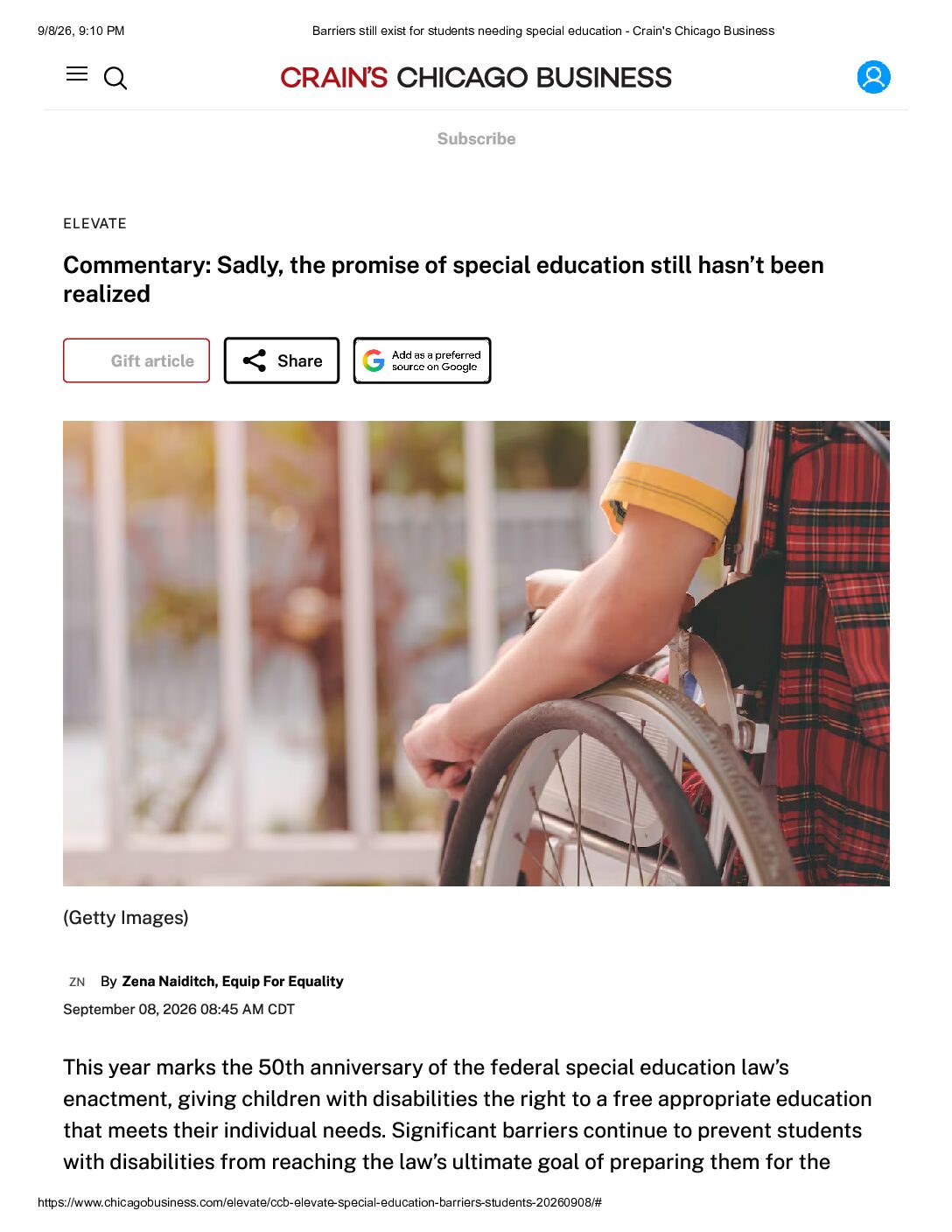
As we celebrate 50 years of the enactment of federal special education law, Zena Naiditch, shares her perspective on the plight of special education in Chicago and throughout Illinois. Chronic underfunding, inadequate staffing and practices that fail to meet the needs of students with disabilities create serious barriers to an equitable and appropriate education. Our work is more important than ever.
Commentary: Sadly, the Promise of Special Education Still Hasn’t Been Realized
By Zena Naiditch, Equip for Equality | September 8, 2026
This year marks the 50th anniversary of the federal special education law’s enactment, giving
children with disabilities the right to a free appropriate education that meets their individual needs. Significant barriers continue to prevent students with disabilities from reaching the law’s ultimate goal of preparing them for the transition to adulthood, including living independently and obtaining employment.
At Equip for Equality, the federally mandated Protection & Advocacy System for Illinois, we see the impact of these shortfalls firsthand. The more than 2,000 annual calls to our Parent Helpline on Special Education Rights illustrate common problems.
Starting with our youngest learners, infants and toddlers ages 0-3 are entitled to free and low-cost therapies through Illinois’ Early Intervention (EI) program. Services are critical during this window of opportunity in which children’s brains are most able to develop language, social attachments, behavioral regulation and other skills vital to future success. Too many students never get these critical services.
Once a student is in the system, there are shortages of specialized programs that support those with the highest needs. At the beginning of the last school year, nearly 300 kindergarten to second grade Chicago Public School students with autism and intellectual disabilities missed out on schooling while they awaited placement in the specialized programs.
Schools are also unnecessarily segregating children with disabilities, despite legal requirements to place them in the least restrictive environment that meets their needs. Inclusive classrooms benefit all students and are the starting place in the law.
Other students are excluded through suspensions, expulsions, shortened school days, restraint,
and seclusion rather than being given the supports they need. Too often students with behaviors are excluded from school instead of given the supports they need to regulate their behaviors, leading to missed education, school dropout, and for too many, even involvement in the criminal system. Too many schools rely on physical restraint and seclusion rather than other non-traumatizing techniques that are effective. Without access to the supports that help them remain in school, these young people are denied the opportunity for a better life, with the real threat of unemployment and a continued cycle of incarceration. Studies, and our own casework, have shown that this cycle is best disrupted through appropriate education interventions.
Finally, the importance of preparing students with disabilities for life after graduation cannot be
overstated. From age 14.5-22, schools are mandated to prepare these youth for independent living, postsecondary education, and employment. Too many students are graduated without the necessary tools or skills to be employed, resulting in high unemployment.
While Equip for Equality continues to support parents and
advocate for their rights and the rights of their students, the sad fact remains that half a century later, the promises of special education law have not been fully realized.
Funding and system reforms are required.
Equally essential is to balance the playing field: parents need to be empowered to be informed, effective advocates for their students so they can work in partnership with the schools as the law envisions.
Source: Crain’s Chicago Business commentary by Zena Naiditch
As Equip for Equality celebrates our 40th anniversary of advancing the human and civil rights of children and adults with disabilities in Illinois, we are grateful to Chicago’s leading corporate law departments and law firms for the thousands of pro bono hours they commit to our Special Education Rights Clinic each year. This cost effective model delivers hope to parents and real improvements in many students performance in school and beyond.
Crain’s Chicago_Special_Education_OpEd